



1. Healthy births from mitochondrial donation
The mitochondrial genome carries about 0.1% of our DNA. Mutations in mitochondrial DNA cause 300 diseases, which affect 1 in 5000 people – with varying severity, including some that cause blindness (Leber hereditary optic neuropathy), and others which are fatal (Leigh syndrome).
Women with mitochondrial disease can pass the condition to their children – because mitochondria, and the DNA it carries, are exclusively passed from mothers to children.
When a woman has a mix of healthy and mutated mitochondria (heteroplasmy) the risk of passing on disease depends on the proportion of mutated DNA. If that proportion is low, preimplantation genetic testing can be used to select embryos with mostly healthy mitochondria – reducing the risk of disease in the child.
But others have very high heteroplasmy – or homoplasmy (all of the mitochondrial DNA is mutated). Preimplantation genetic testing can't work here, and these women currently have no options to have their own (genetically-related) children - without the risk of transmitting the disease.
Aiming to solve this problem, these are two reports, in NEJM this week, of 8 healthy births from mitochondrial donation, where the nuclear DNA comes from parents but mitochondrial DNA comes from a donor.
Here’s how it works:

And here’s what it looks like under the microscope:
All 8 babies are developing normally, and all have healthy (or mostly healthy) mitochondria – the oldest is just over 2!
This technique (which is called ‘mitochondrial donation by pronuclear transfer’) is still only offered at a small number of centres in the UK – and long-term safety is still being monitored, but trials are also underway in Australia, Mexico, Ukraine, and China.
The reports were published in NEJM this week (The first, and the second).
2. Improving therapy for Crohn’s disease
Crohn’s disease, a type of inflammatory bowel disease, can cause inflammation anywhere along the gastrointestinal tract – from mouth to anus. It affects around 10,000,000 people globally.
Medications for Crohn’s disease aim to suppress this inflammation. They’ve progressed a lot over the last decades, starting with steroids and moving into the biologics era:
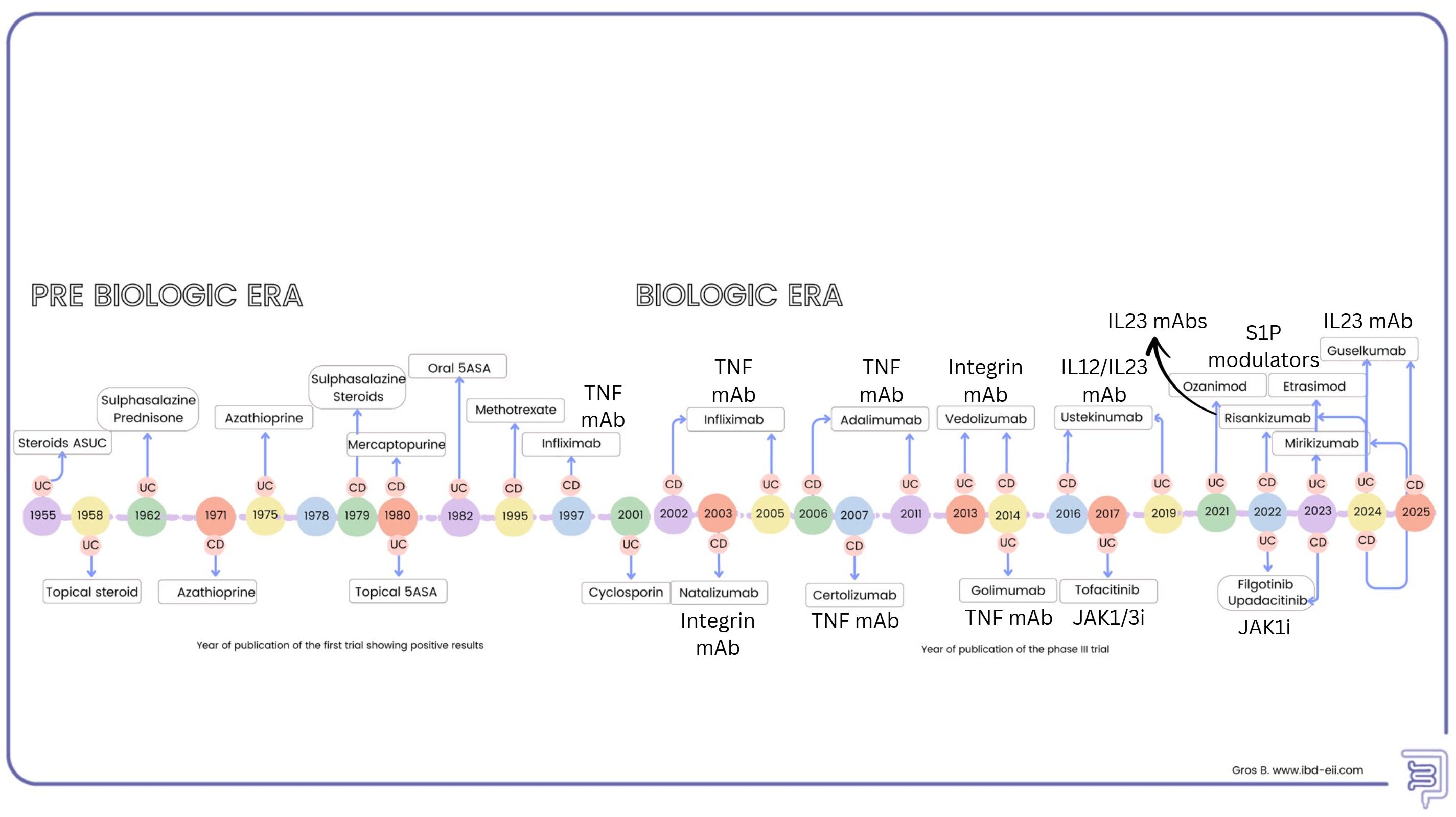
The latest Crohn’s therapies are inhibitors of IL23, an inflammatory cytokine, based on the idea that IL23 is the main driver of pathology in Crohn’s disease. This dates back to 2006, when single nucleotide polymorphisms that reduce activity of IL23’s receptor were found to be protective against Crohn’s disease:

IL23 blockers inhibit the p19 subunit – which is only in IL23 – while combined IL12/IL23 inhibitors target p40 – which is shared by both IL12 and IL23.
So far, first generation IL23 blockers (Mirikizumab and Risankizumab) have not proven superiority over combined IL12/IL23 inhibition – as first line therapy.
That’s where Guselkumab comes in. Unlike the previous generation inhibitors it both inhibits and depletes IL23.
Tested as first- or second-line therapy, and used as both induction and maintenance, IL23 inhibition with Guselkumab was better than combined IL12/IL23 inhibition (with Ustekinumab):
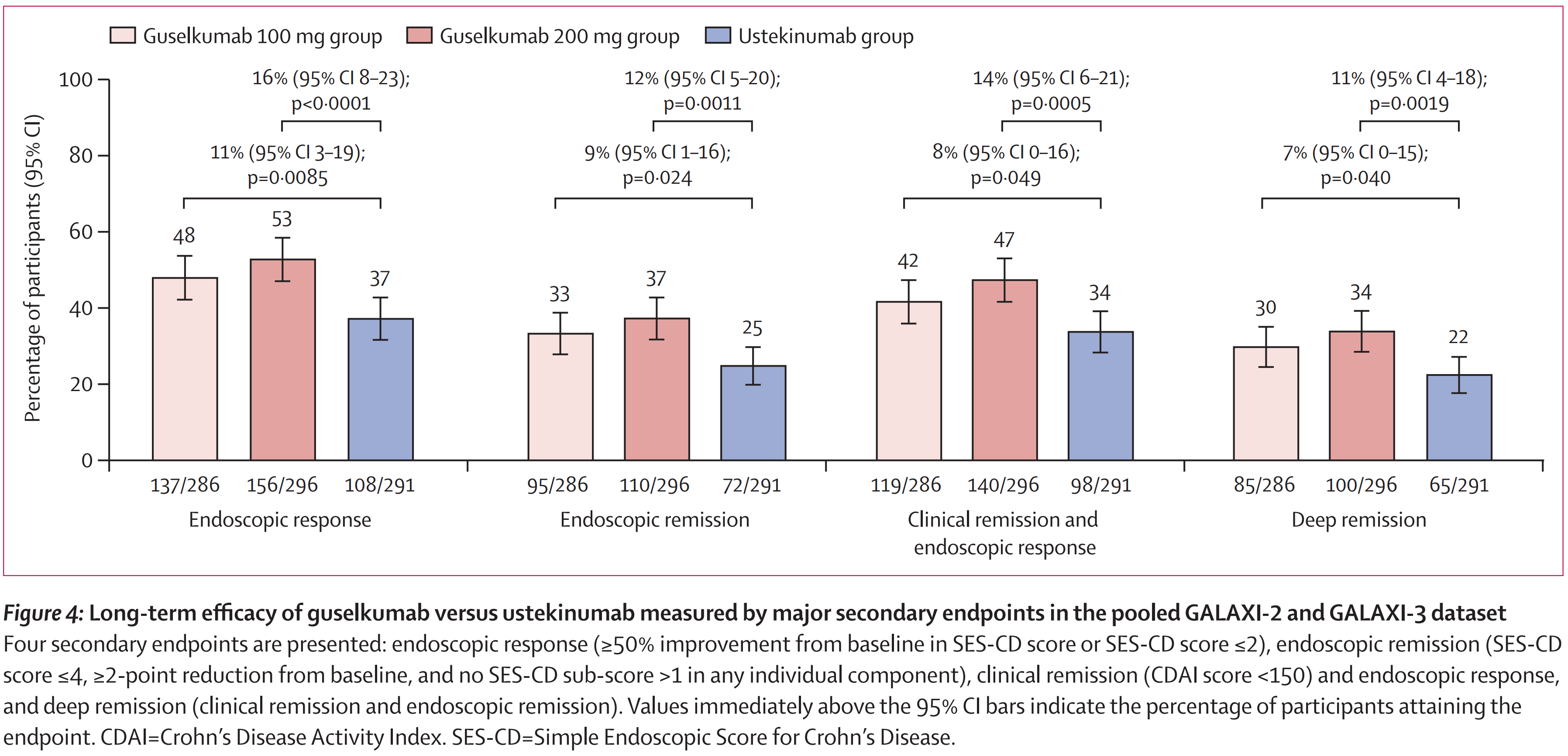
50% endoscopic response and 34% deep remission is impressive, but it shows how difficult it is to induce remission in Crohn’s and the space for future progress.
Now that IL23 inhibition has emerged as a front-runner, head-to-head trials vs. the other biologics – and against previous generation IL23 inhibitors – will help figure out which therapy is definitively best, and for which patients.
It was published in The Lancet this week.
3. Common medications affect the gut microbiome
The bacteria in the gut – the gut microbiome – have a number of roles. They protect us against infection, they help resist cancer, they help digest food, they affect mood and cognition, and they might even mediate the beneficial effects of exercise.
But the medications that we use can affect the gut microbiome. For example, some drugs – like the antidepressant, sertraline, has antibiotic properties, which can provoke antibiotic resistance.
This study, in Nature this week, does a huge epidemiological analysis of commonly-taken medications associated with increased risk of gastrointestinal infections.
