


1. Adults can produce new neurons, after all
A decades-old problem is whether adults can produce new neurons. It’s been proven in rodents – but never in humans. The neuroscientist, Cajal, who figured out the structure of neurons – and famously drew them – said that brain cells are “fixed, ended, and immutable”.
If we can make new neurons – and if we could figure out where they are and how it happens – it could revolutionise our understanding (and potentially treatment) of disorders like dementia.
This team makes the stunning discovery that the full pathway of new neurons - from the stem cells to the neuroblasts – can be found in the adult hippocampus. Neural stem cells are the ‘parent’ cells, intermediate progenitor cells are the ‘children’ and neuroblasts are the ‘teenagers’ – on their way to becoming fully-formed neurons:
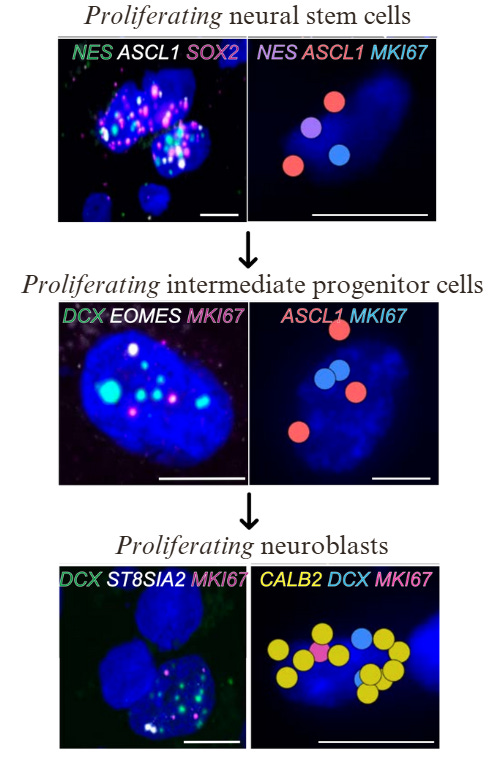
The study used donors from accredited brain banks. 6 of the brains were from children: all had neural progenitors. 6 were from adolescents: progenitors were rarer – but present. 13 were from adults: progenitors were rarer still – but present!
This makes sense: neurogenesis is less active in adults than in the developing brain. There was also substantial variation between people, with some adults not producing new neurons at all.
So, how did they do it?
The key innovations were 1) enriching proliferating cells using an antibody against the proliferation marker, Ki67 2) training AI models to identify progenitors and 3) using a new technique, Xenium, which uses spatial transcriptomics to scan hundreds of genes at once – and draw a high-resolution map of where they are.
Like any good discovery, this raises a lot of questions.
Why did some adults produce no new neurons, while others produced many? Is there a relationship between the birth of new neurons and cognition? Depression? Dementia?
Now the discovery’s been made, it’s time to figure it out.
Here’s the source.
2. Specific targeting of chronic inflammation
Inflammation is the devil that drives disease. Cancer, cardiovascular disease, dementia – they’re all underpinned by inflammation. But it’s not acute inflammation – this protects us against infection. It’s chronic inflammation that’s the problem.
Unpicking chronic inflammation from acute inflammation is hard. If chronic inflammation is blocked, acute inflammation is usually blocked, too. Here’s what the current landscape of anti-inflammatories looks like:
Recent attempts to target chronic inflammation include inhibition of the cytokine, IL1β, which reduced the risk of lung cancer and cardiovascular disease. But it also inhibits acute inflammation – so there’s an increase of severe infection (sepsis) too, which means it never got approval.
Possibly the most promising emerging approach is blocking the cytokine, IL6. Indeed, this brings down the marker of chronic, systemic inflammation (high sensitivity CRP), but whether or not this can actually reduce the risk of cardiovascular disease, cancer or dementia isn’t yet known – the trials are still underway.
So, we still need new targets that separate chronic from acute inflammation – which is where this discovery comes in.
This team noticed that the chromatin remodelling protein, WSTF, disappears in chronic inflammation but stays intact in acute inflammation.
