


Five years ago, Pfizer discontinued development of brepocitinib. Priovant paid $10 million upfront for it (plus 25% equity) and, this year, it was FDA-approved for dermatomyositis, with expected peak annual sales of $2B. Pfizer didn’t discontinue it for a lack of efficacy, but for strategic reasons.
This idea — licencing discontinued drugs — is used by a number of companies, including Priovant, Oak Hill Bio, and Ignota Labs. That made us think: what drugs have pharma discontinued this year, and which of them might be future blockbusters?
Background
Pharma companies discontinue many more drug programs than they used to, with ~15% of all phase 2 and ~8% of phase 3 trials now discontinued. The main reason is not poor clinical data — it’s strategic, which explains discontinuation in about half of all cases. That’s shown in the following figure.
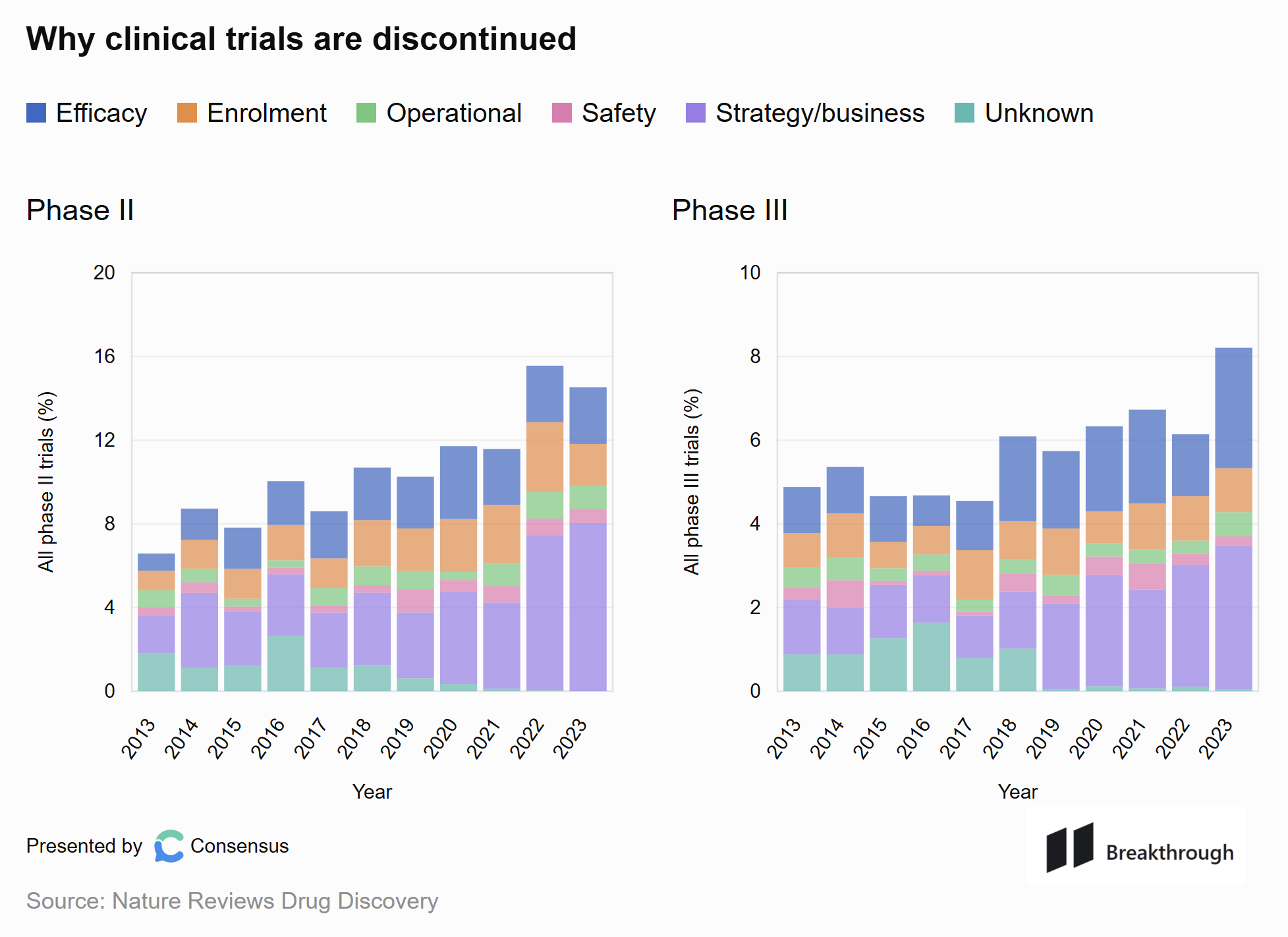
Strategic reasons include portfolio prioritization — for example, choosing one promising drug over another competing candidate. Enrolment reasons include competition for the same pool of patients in a clinical trial. And operational reasons include manufacturing problems — for example, a shortage of drug that prevents a trial from continuing.
What drugs have pharma discontinued in 2026?
To map the programs discontinued this year, we searched the pipelines of the top 30 pharma companies.
Methods
We searched for drug discontinuations between 1 January and 17 November 2026. We included the top 30 pharma companies, based on 2025 revenues — 20 globally and 10 in China. We checked earnings releases, investor presentations, pipeline tables, regulatory filings, press releases, ClinicalTrials.gov, the Chinese CDE trial registry, EU CTIS, SEC filings, and peer-reviewed papers.
To do this, we used Codex and the Consensus plugin. You can try Consensus for free, using my link.
We found 225 discontinued programs. Looking for the most compelling assets, we ranked the top 15, focussing on novelty and those not discarded due to poor clinical data. Some of them really are fascinating: there are drugs with established clinical efficacy (like Gilead’s helicase-primase inhibitor), with first-in-class mechanisms (like Pfizer’s EGFR γδ T cell engager), and combinations of established modes-of-action in single molecules (like Chai Tai Tianqing’s GLP1-FGF21 fusion protein).
Those top 15 are shown in this table:
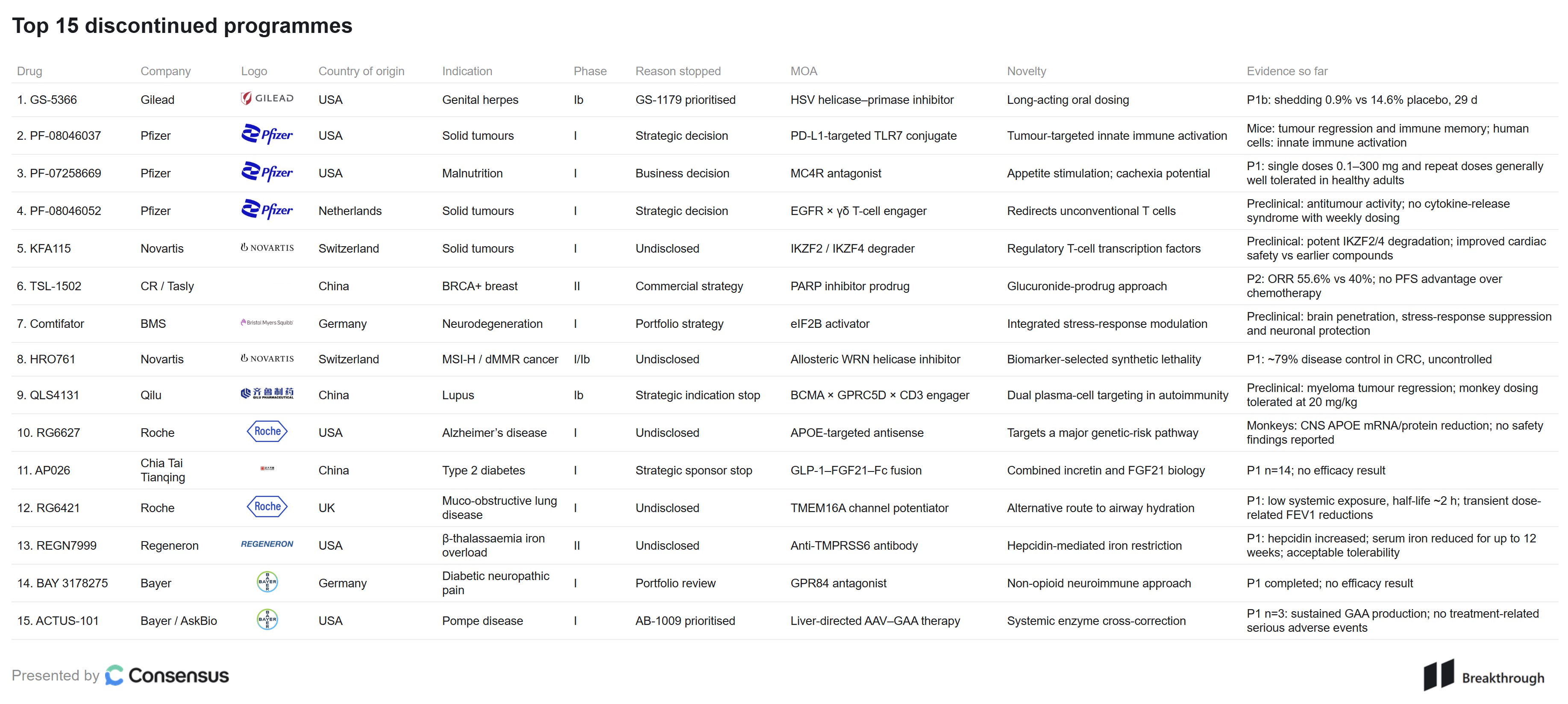
To give a bit more detail on the top 5 programs from the table above:
GS-5366 (Gilead): This is a long-acting (once-weekly or -monthly) helicase–primase inhibitor, for genital herpes. The mechanism’s not new, but in an early clinical trial it showed viral shedding on <1% of days versus ~15% with placebo. So there’s clear antiviral activity in humans, but it was discontinued in favour of Gilead’s newer candidate, GS-1179.
PF-08046037 (Pfizer): This is a novel PDL1-targeted TLR7 agonist conjugate — designed to activate innate immunity within tumors. Mouse studies showed it was active against tumors, with durable immune memory, but Pfizer discontinued it for strategic reasons.
PF-07258669 (Pfizer): This is an oral MC4R antagonist that stimulates appetite, with potential use in cancer cachexia. This target has very strong genetic evidence, and MC4R agonists are already used for inherited obesity. Phase 1 results showed it was safe and tolerable in healthy volunteers, but it was discontinued for business reasons.
PF-08046052 (Pfizer): This is a first-in-class EGFR-targeted bispecific antibody that recruits γδ T cells (rather than conventional αβ T cells) to cancer cells. Preclinical studies demonstrated tumor cell killing and improved survival, without observed cytokine release syndrome. Pfizer terminated it for strategic reasons, explicitly excluding safety concerns.
KFA115 (Novartis): This is a molecular glue degrader of IKZF2/IKZF4 — it aims to stimulate anti-tumor immunity by inactivating immunosuppressive Tregs. Preclinical studies demonstrated potent degradation and a better cardiac safety profile than previous molecular glues, but Novartis discontinued it for portfolio prioritization reasons.
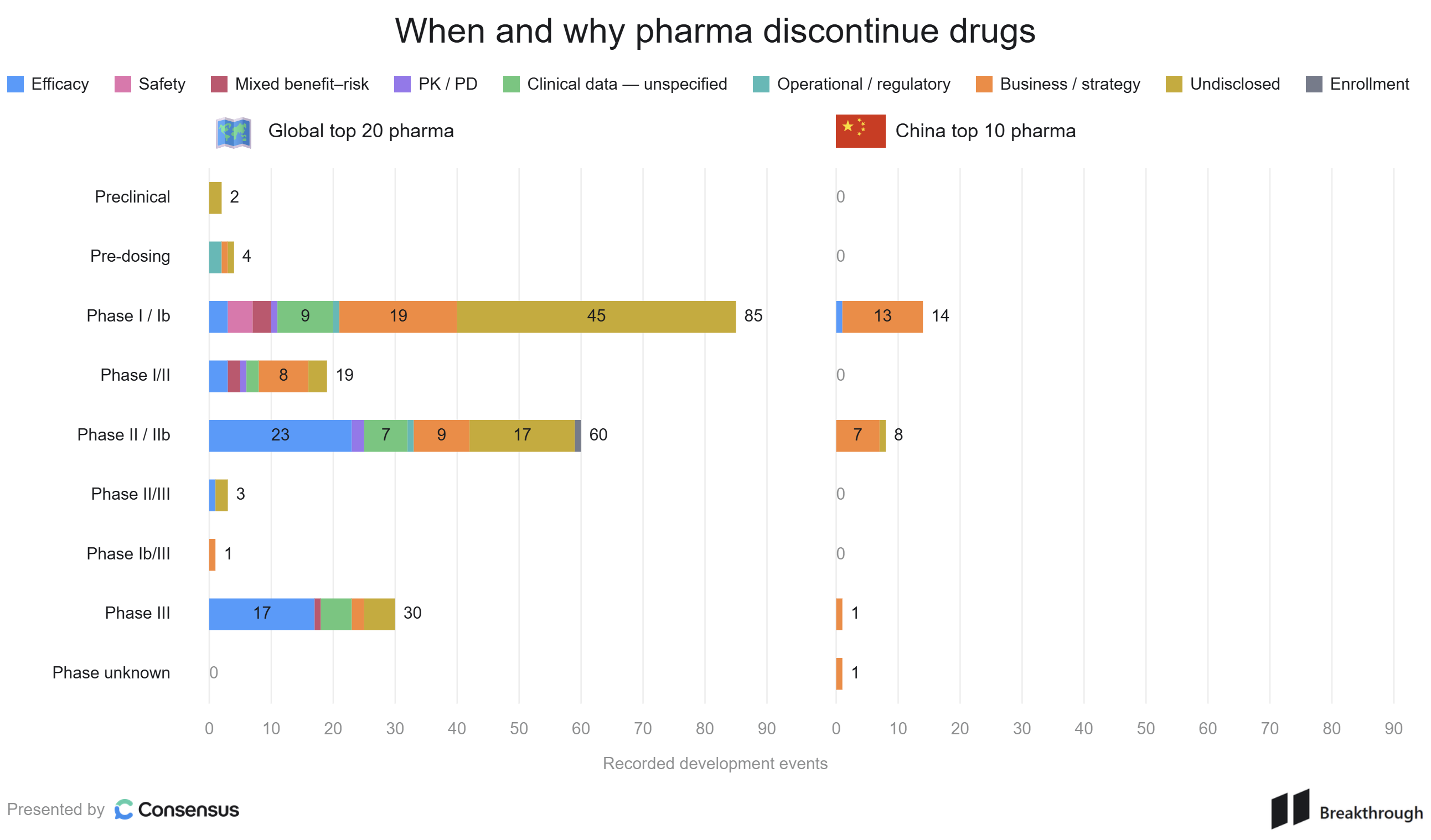
Of the 225 programs discontinued this year, 47.5% of were in phase 1, 37.5% in phase 2, and 15% in phase 3. The commonest disclosed reason for discontinuation was strategy (27.2% of trials) followed by efficacy (21.1%), clinical data (10.1%), mixed benefit-risk (2.6%), safety (1.8%), pharmacokinetics/pharmacodynamics (1.8%), operational/regulatory (1.8%), and enrolment (0.4%).
That analysis, split by global and Chinese companies, is shown here:
Roche has discontinued the most programs this year, with 34, followed by Pfizer (33) and Astrazeneca (24), as shown here.