


The history and development of medicine is marked specifically by certain events and individuals. The story of schistosomiasis, hepatitis C, Raymond Schinazi, Michael Sofia and a drug called Sofosbuvir is one worth recounting. Its influence on contemporary medicine and society is hard to overestimate, and, as you might expect, starts with schistosomiasis.
Discovered in the 19th century by Theodor Bilharz in Egypt, the trematode species termed schistosomiasis causes gastro-intestinal, urogenital and disseminated infections in susceptible individuals. S. haematobium, specifically infecting the urinary tract, predisposes to bladder cancer. This parasite is dependent on certain snails for its life cycle, and infects humans as an intermediary host if they come into contact with fresh water.
Rather rare in Egypt before 1900, S. haematobium gained grounds following the building of a major dam on the Nile. This massive construction project put thousands in direct contact with the Nile, and likely increased prevalence of the snails. Consequently, prevalence of S. haematobium increased - in certain regions, up to 75% of individuals were infected.
Starting from 1928, Egypt started treating its population with the only drugs available at the time. A grueling regimen of up to 21 injections with antimony compounds could cure schistosomiasis, at the cost of severe acute adverse events such as arrhythmias, but also at risk of Hepatitis C.
Hepatitis C in Egypt
An excerpt of a WHO-commissioned report by Brian Maegraith’s, Australian-born Oxford-trained pathologist, from 1964 is shown below. It highlights the incomprehensible scale of the schistosomiasis treatment effort.
The stranger to mass therapy with Tartar Emetic is certainly to be confounded by the speed and apparent safety of the administration of the drug.
The skillful doctor began injecting at 9:20 and had completed 504 injections of men, women, and children by 10:10 am. Allowing for a 10-min rest, the time taken for each injection was thus under 5 seconds. This remarkable performance is being repeated at various tempos all over Egypt.
The used syringe is placed in an ‘out’ tray, from which it is taken by the nurse, washed through, and boiled for a minute or two. As soon as the syringe is cold, it is filled with a volume of the drug solution it is then placed in the “in tray” ... There are usually 20 to 30 syringes in rotation.
It is clear that such practices, reusing needles without proper sterilisation, poses risks for transmission of blood-borne infections. Indeed, hepatitis C, at that time known as non-A-non-B hepatitis spread like wildfire through Egypt.
At a certain point, over 10% of individuals in Egypt had been infected by this virus. Being a major risk factor for cirrhosis and liver cancer, it caused an enormous burden on Egyptian society, healthcare and economy.
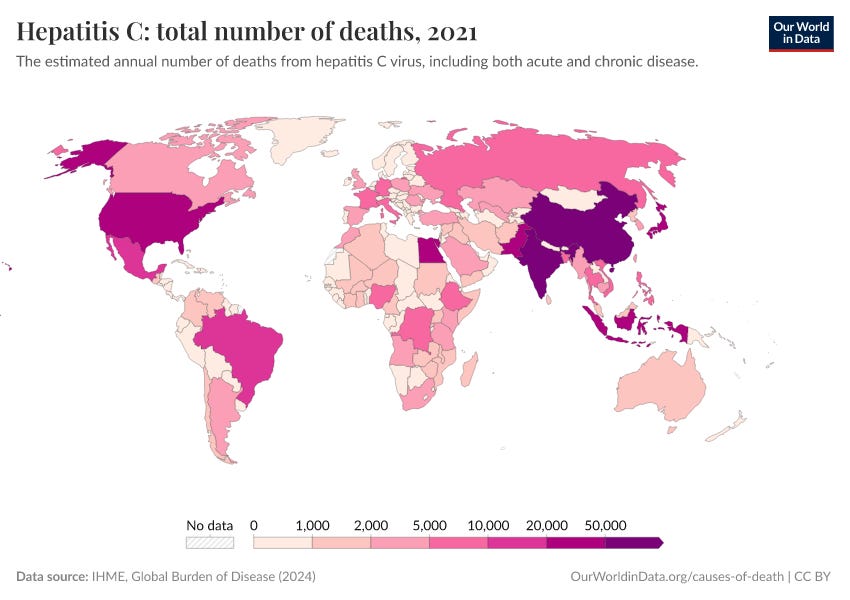
Total number of deaths due to Hepatitis C in 2021. IHME, Global Burden of Disease (2024) – with minor processing by Our World in DataDeveloping a cure for Hepatitis C
Starting from the 80’s, treatments emerged for hepatitis C. Administering immune stimulating drugs, known as interferon, to hepatitis C patients helped some to clear the virus. This came at the cost of often year-long treatment plans with adverse events such as depression, psychosis, flu-like symptoms and more. Needless to say, unpopular and quite ineffective on a population scale.
