


The topic of aspirin in cancer is scorching hot. A study in mice lead by Cambridge researchers published in Nature in March 2025 and a short article by two researchers in NEJM from december 2025 are fueling the enthusiasm.
The Cambridge study shows thromboxane A2 (TXA2) suppresses T-cell immunity by inducing senescence, limiting T-cell division and blocking signalling through the T-cell receptor. All of these elements are vital in anti-tumour immunity.
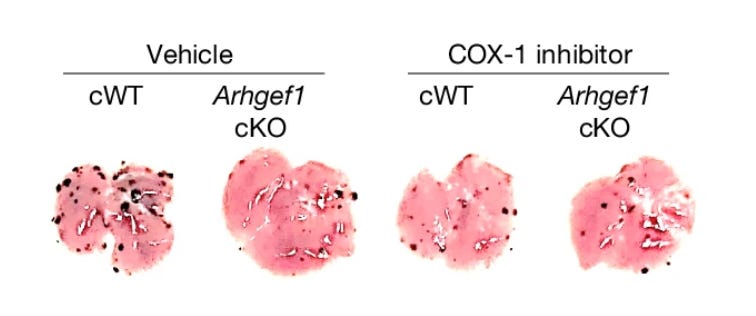
TXA2 is mostly produced by platelets by the COX1 enzyme. Aspirin is a potent COX1 inhibitor, lowering TXA2 production. As it appears, in murine tumour models, aspirin reduces the development of metastases. This is evident in the image below, showing melanoma metastases in the liver: mice treated with aspirin, or those genetically engineered to not respond to TXA2 (by deleting the Arhgef1 gene) clearly developed fewer metastases.
I get why a lot of people are enthusiastic about aspirin in cancer. A drug costing a few cents per day with a well known safety profile stopping cancers from spreading would be an incredible development. This would be a prime example of a successfully repurposed drug - if it would actually work in humans.
Repurposing drugs - rarely a success
Everyone loves a low cost repurposed drug. Dexamethasone in severe COVID-19, SGLT2-inhibitors for heart failure and thalidomide for multiple myeloma are some successful examples. Most repurposed drugs fail, however.
A Cambridge University investigation reviewed 834 drugs trialed between 1980 and 2012, of these, 2% were eventually successfully repurposed. Not all were investigated for repurposing though. Repurposing rates and subsequently success rates largely depend on whether they were repurposed to a similar disease or not, and whether the drug was successful for it’s initial indication or not. The graph below shows what percentage of drugs were repurposed, depending on these variables.
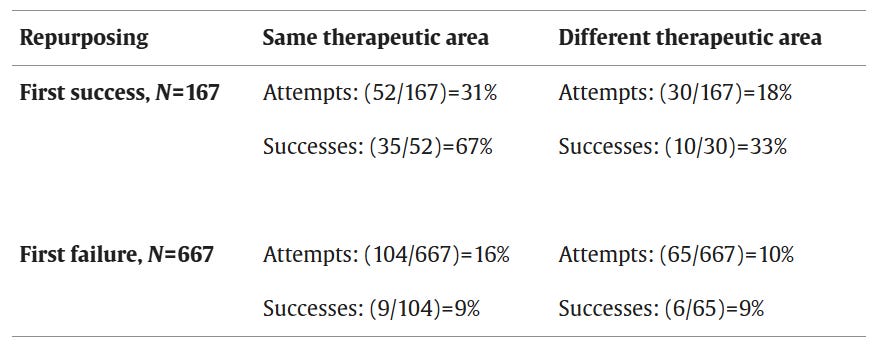
While these success rates are higher than for newly developed compounds, especially for drugs that are successful for their primary indication, we should keep our cool - most will still fail.
The history of aspirin and cancer
While the first written account of salicylates dates from 1897, substances containing salicylates had been used thousands of years ago. Salicylates naturally occur in plants, and are essential in plant immunology.
I heard John Burn, renowned geneticist and cancer researcher at Newcastle University, point this out in a talk once. A plant sensing an infection needs to adjust its priorities: eliminate the infection before continuing growing. Plants ramp up salicylate production in infections and through various mechanisms, these compounds boost antimicrobial immunity and slow cell division.
This is exactly what cancer researchers are after - something to stop aberrant cell growth and boost the immune system. Supported by observational and animal studies, John Burn, in the 1990’s, started an important trial investigating the antitumoral properties of aspirin. The CAPP trials were born.
In patients with familial predispositions to cancer due to a mutation in the APC gene, associated with increased risk of colon polyps and cancer, the CAPP1 trial showed aspirin reduced polyp size. In people with Lynch syndrome, due to a mutation in DNA-correcting genes, aspirin also reduced colon cancer diagnoses in the CAPP2 trial.
Interestingly, patients with Lynch syndrome also suffer a predisposition for other cancers. These do not seem to respond to the aspirin treatment - there was no significant difference between the incidence of non-colorectal cancers typically associated with Lynch syndrome in treated patients.
The case against aspirin in cancer
The research on aspirin in people living with a genetic predisposition to colon cancer is practice changing. In some guidelines, aspirin is now recommended for patients with Lynch syndrome. There’s less clarity beyond this very specific patient population.
While we would need more trial data to make definitive conclusions, there is a handful of well-powered randomised controlled trials. One of those, the Alliance A011502 trial, published in JAMA in 2024 investigated aspirin as an add-on to non-metastatic breast cancer following local treatment in about 3000 patients. This trial was stopped early as it appeared that more patients in the aspirin group developed metastases.
Similarly, the ASPREE trial, a large randomised controlled trial performed in Australia in healthy individuals, showed an increased rate of metastatic cancer diagnoses in those allocated to the aspirin group. This trial involved over 19,000 participants followed over 4.7 years.
