


ESMO — the European Society for Medical Oncology — starts on Friday! Alongside ASCO (the American version, in May) this is where the world’s frontier cancer trials are presented.
There’s a slightly overwhelming amount of data, including 861 clinical trials across posters and oral presentations. So, to help get your head around what’s to come, here we rank it all, by therapeutic novelty.
Methods
We divided therapeutic novelty into 5 tiers.
Novelty tier 1: New targets. Either the first time this mechanism has been tested in humans, or its first clinical milestone (for example, the first phase 2 or 3 data).
Novelty tier 2: New modality, known target. For example, something that degrades (not inhibits) a known target, or a bispecific antibody against two known targets.
Novelty tier 3: Differentiation of known target. For example, a brain-penetrant inhibitor of an established target, or an oral version of an intravenous drug.
Novelty tier 4: New combinations of established mechanisms. For example, combining RAS inhibition with PD1 blockade.
Novelty tier 5: A new use of an established treatment. For example, an established drug tested in a new cancer type.
We used the ESMO abstract book as the source. For the surrounding research, we used Consensus.
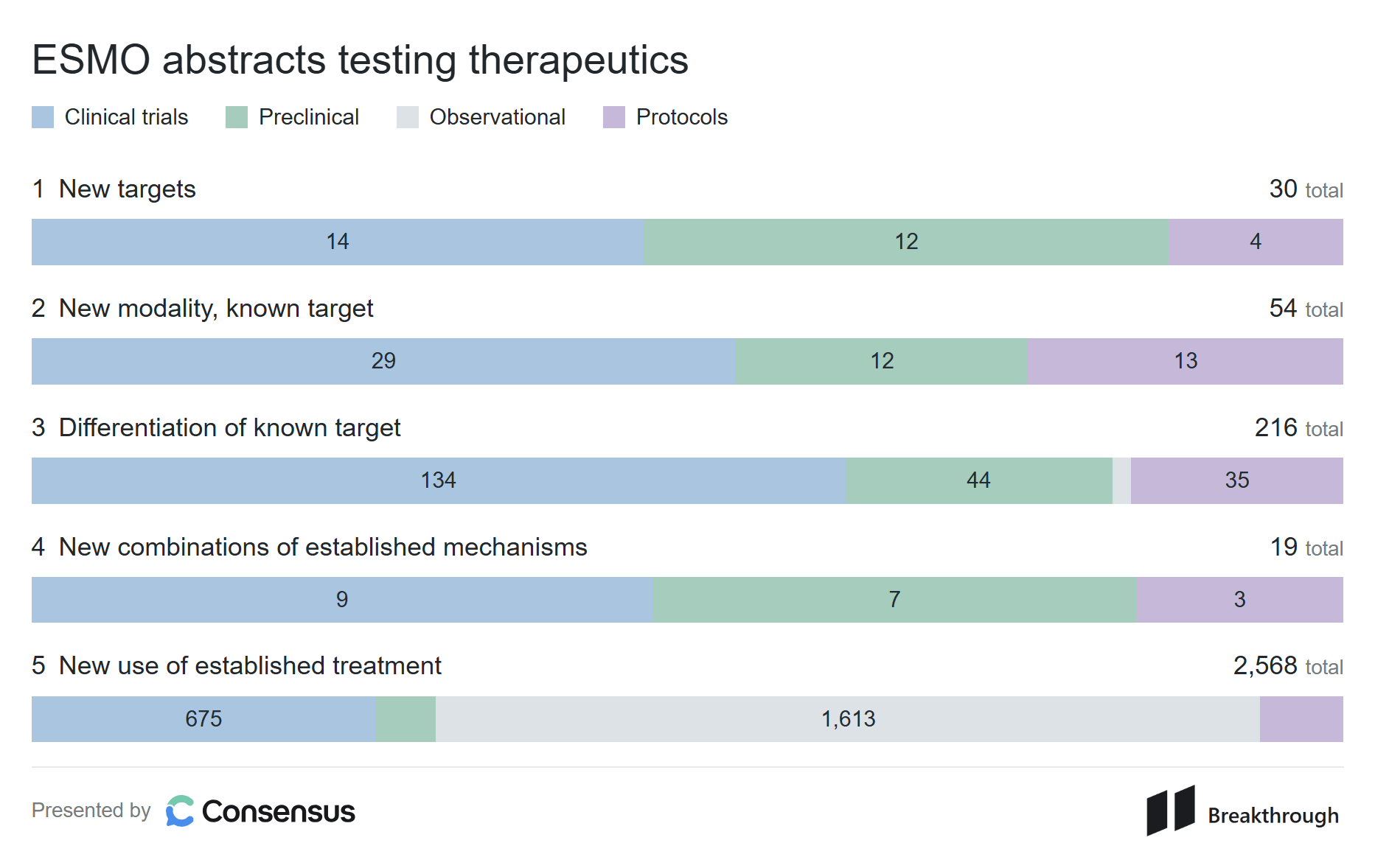
By our analysis, 14 of the 861 clinical trials test a new therapeutic target (Novelty Tier 1), 29 a new modality for a known target (Novelty Tier 2), 134 differentiate on a known target (Novelty Tier 3), 9 use a new combination of established mechanisms (Novelty Tier 4), and 675 use an established treatment in a new way (Novelty Tier 5) — as follows.
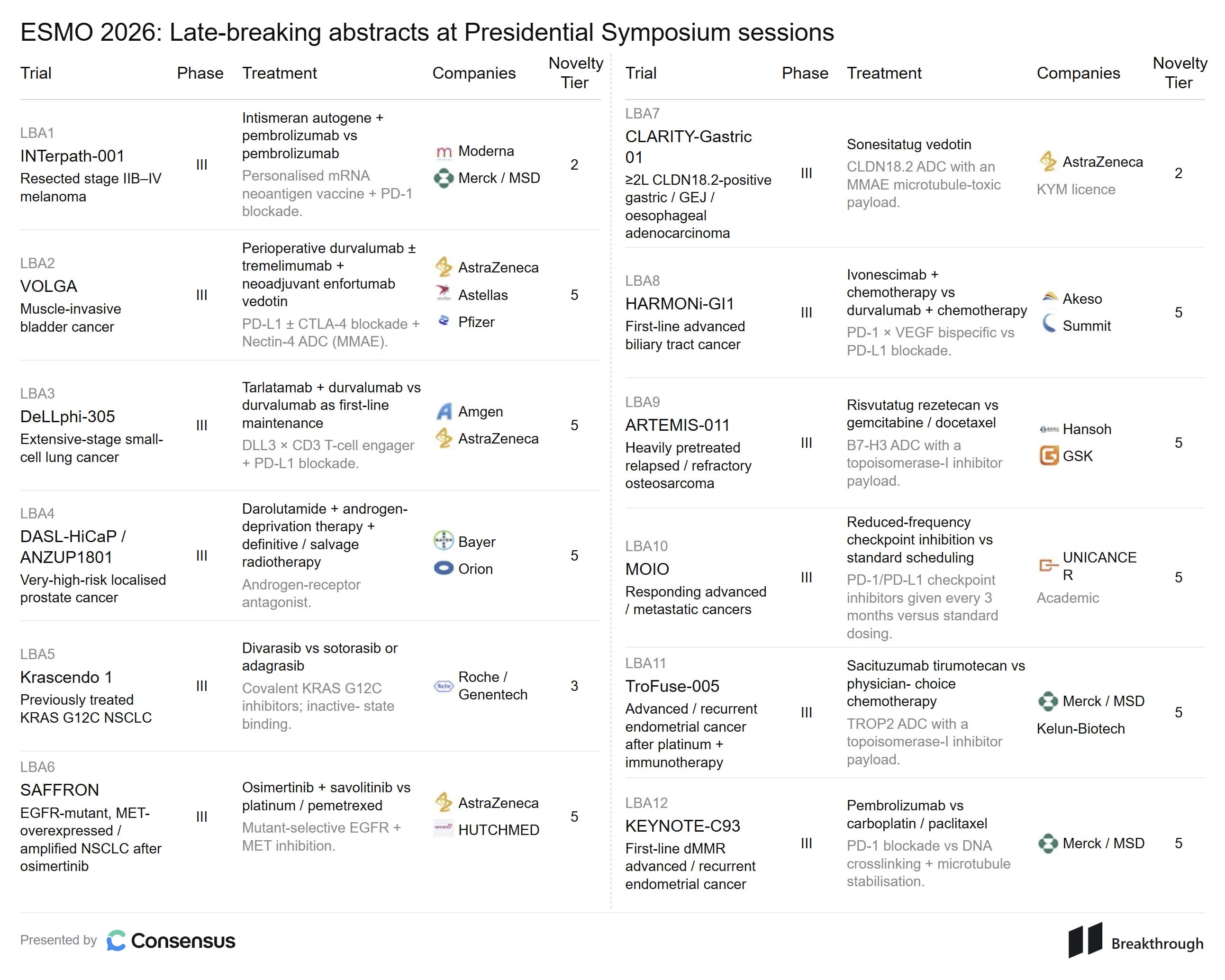
This analysis — novelty — is quite different from clinical significance. To demonstrate that, the following figure, which we put together, shows the late-breakers at the ‘Presidential Symposium’ sessions (the potentially practice-changing talks judged to be most important). Of these, we rank none as Novelty Tier 1, two as Tier 2, one Tier 3, none Tier 4 and nine Tier 5.
The 14 clinical trials presenting new data for genuinely first-in-class medicines are shown in the table below.
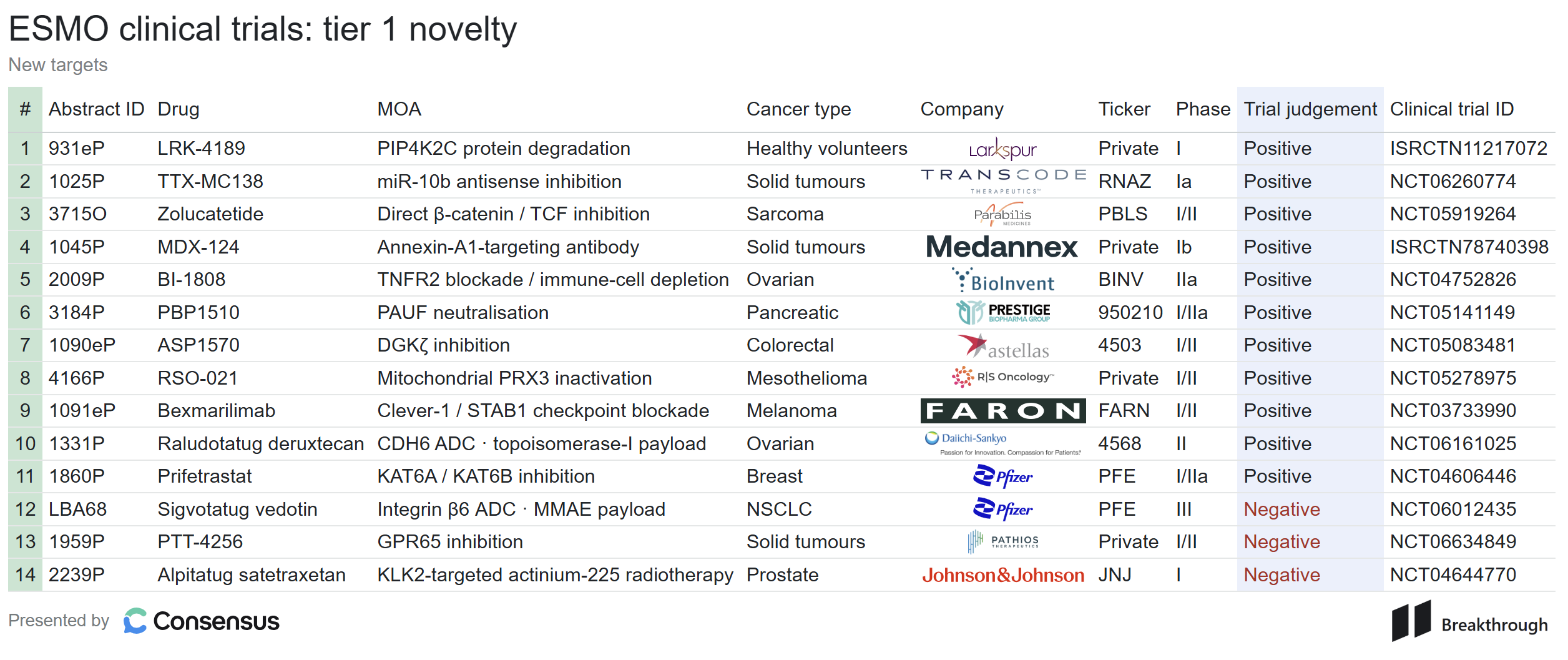
Here’s a bit more detail on each of those programs.
1. LRK-4189 (Larkspur, Private): The first clinical degrader of PIP4K2C, a lipid kinase that helps cancer cells survive metabolic stress and evade immune surveillance.
2. TTX-MC138 (TransCode, RNAZ 0.00%↑ ): The first clinical miR-10b antisense oligonucleotide, which inhibits a metastasis-associated microRNA.
3. Zolucatetide (Parabilis, PBLS 0.00%↑ ): The first clinical drug to directly disrupt β-catenin–TCF interactions, blocking oncogenic Wnt signalling.
4. MDX-124 (Medannex, Private): The first clinical annexin A1 antibody — to inhibit tumor growth, migration and immune evasion.
5. BI-1808 (BioInvent, BINV 0.00%↑ ): The first clinical TNFR2 antibody — to deplete immunosuppressive regulatory T cells.
6. PBP1510 (Prestige Biopharma, 950210): The first clinical antibody targeting PAUF, a secreted protein associated with pancreatic cancer progression, metastasis and immunosuppression.
7. ASP1570 (Astellas, 4503): The first clinical DGKζ inhibitor — aiming to remove an intracellular brake on T cell activation.
8. RSO-021 (RS Oncology, Private): The first clinical mitochondrial PRX3 inhibitor — to overwhelm cancer cells’ antioxidant defences, triggering oxidative stress and cell death.
9. Bexmarilimab (Faron, FARN): The first clinical CLEVER-1/STAB1 checkpoint inhibitor — to reprogram immunosuppressive macrophages.
10. Raludotatug deruxtecan (Daiichi Sankyo, 4568): The first CDH6-targeted ADC to reach phase 2/3.
11. Prifetrastat (Pfizer, PFE 0.00%↑ ): The first clinical KAT6A/B histone acetyltransferase inhibitor — to disrupt epigenetic programs sustaining hormone-dependent breast cancer.
12. Sigvotatug vedotin (Pfizer, PFE 0.00%↑ ): The first integrin β6-targeted ADC to reach phase 3. This trial was negative.
13. PTT-4256 (Pathios, Private): The first clinical GPR65 antagonist — to reverse acid-driven immunosuppression within the tumor microenvironment. This trial was negative.
14. Alpitatug satetraxetan (Johnson & Johnson, JNJ 0.00%↑ ): The first clinical KLK2-targeted actinium-225 radiotherapy — delivers alpha radiation to prostate cancer cells. This trial was negative.
Here’s the full analysis of all trials, starting with the Novelty Tier 2 trials: