


Research from the quantitative hedge fund, Verdad, found that the segment of the biotech universe with the strongest returns is the smallest companies with the most specialist ownership — almost 30% annualized returns since 2013. Here, we reproduce those findings and apply them to today’s companies, producing a full ranking.
This is research not investing advice!
Do smaller companies generate better returns?
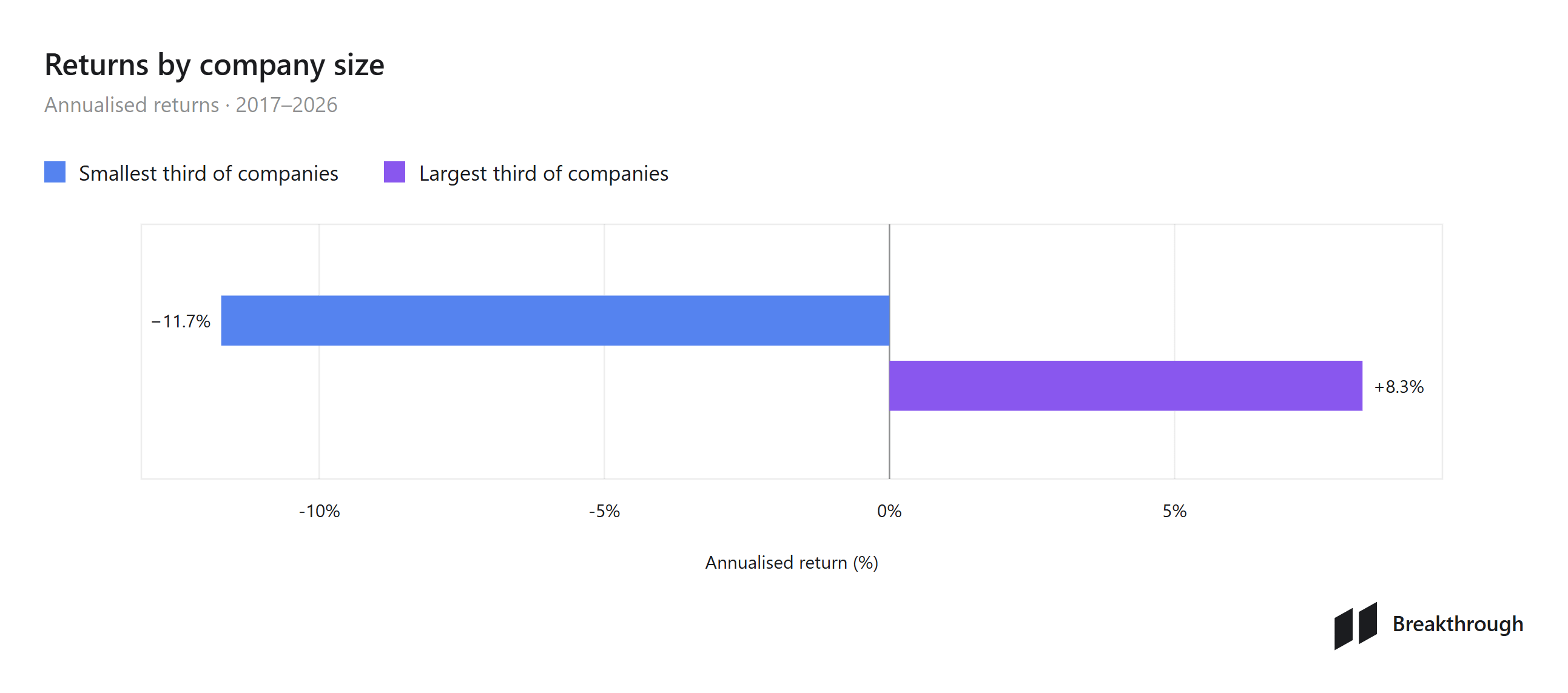
To test whether smaller companies themselves generate better returns (irrespective of specialist ownership) we separated the companies into the smallest and biggest thirds by market cap, rebalanced quarterly, and measured their subsequent compounded returns from 2017 to 2026.
The average annualized returns for the smallest third of companies was -11.7%, and +8.3% for the biggest third. The pattern is clear: smaller companies tend to do worse.
Do smaller companies — with more specialist investors — generate better returns?
So smaller companies actually do worse — but what if they are split by specialist concentration?
Specialist holders: any institutional investor where >50% of their reported book is biotech.
Specialist concentration score: an equal weighting of three percentile ranks — number of specialists; total stock (%) held by specialists; and the ratio of specialists to total institutional investors.
We found that, for both the biggest and smallest companies, higher specialist concentration predicts higher returns — and more-so for the small companies. Small companies in the top decile of specialist ownership averaged +26.2% annualized returns (+17% for the big companies); small companies in the bottom decile of specialist ownership annualized -24.4% (-3.2% for the big companies).
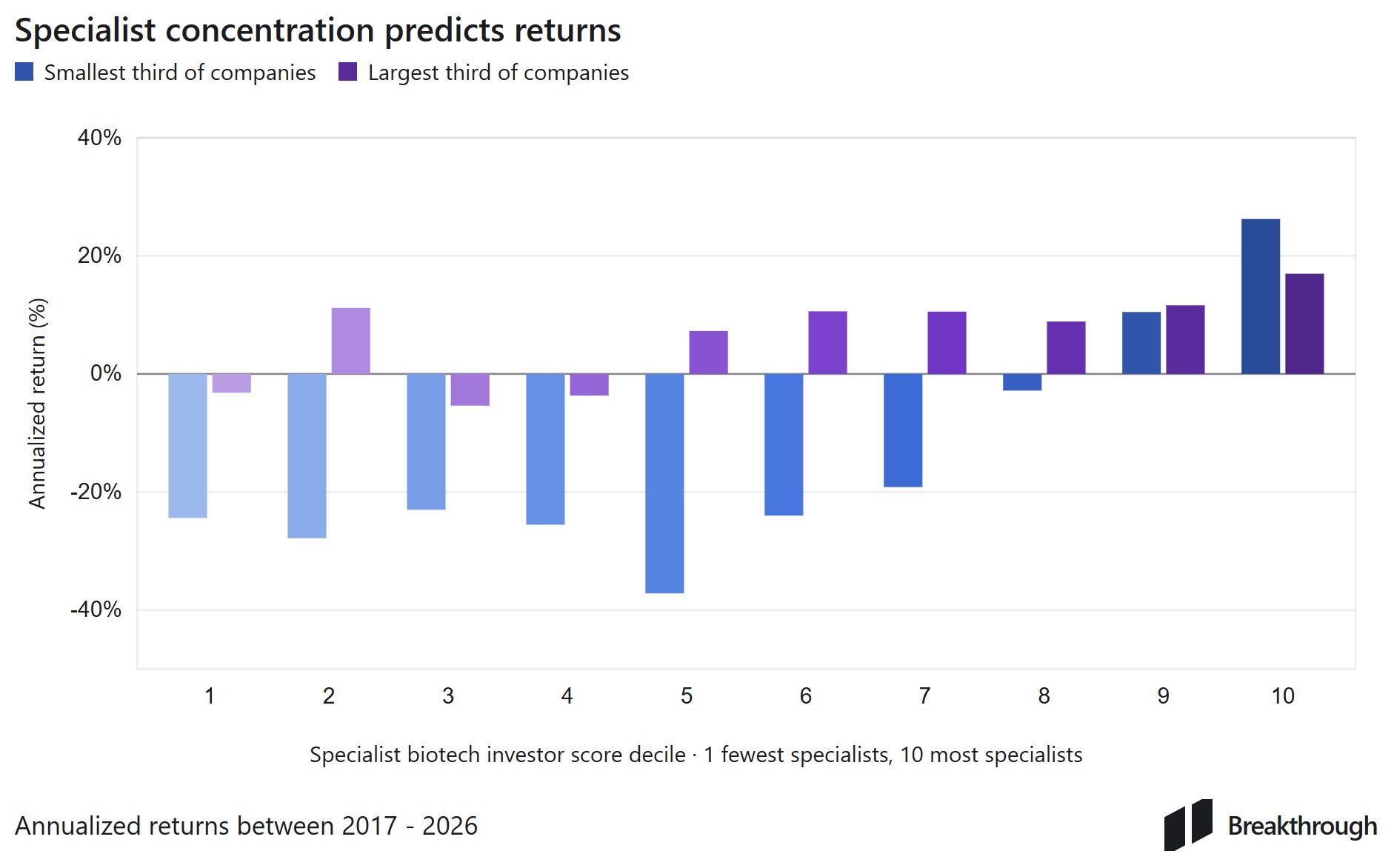
So, this successfully reproduces the Verdad analysis, which begs the next question: which of today’s smallest companies have the highest concentration of specialist investors? Here are those companies:
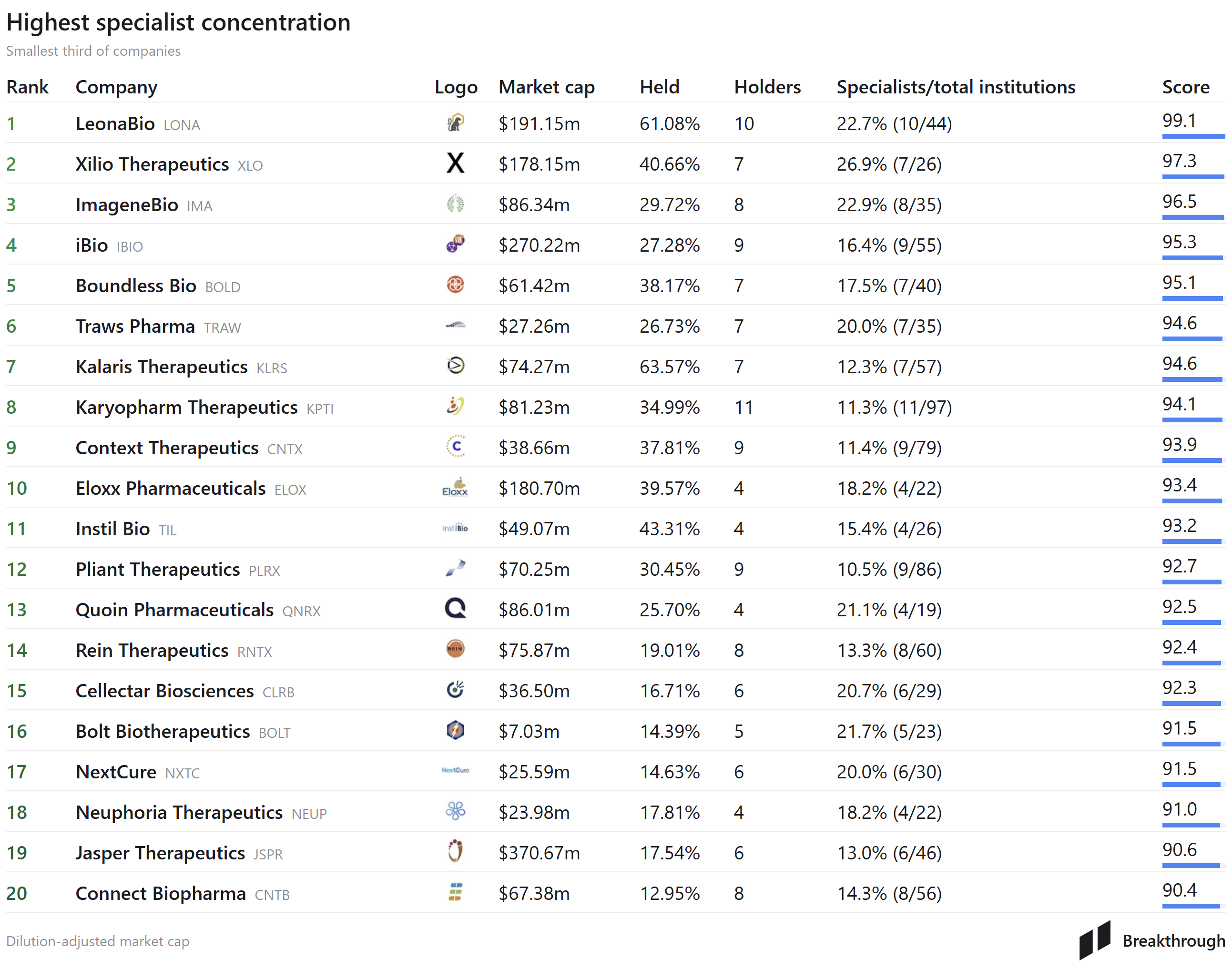
This score doesn’t take the science itself into account, but, out of curiosity, these are the lead programs for the top 10:
LeonaBio LONA 0.00%↑: Lasofoxifene — oral selective estrogen receptor modulator for ESR1-mutant ER+/HER2− metastatic breast cancer.
Xilio XLO 0.00%↑: XTX501 — tumor-activated PD1 × masked IL2 bispecific for NSCLC/solid tumors.
ImageneBio IMA 0.00%↑: Olevaprubart/IMG-007 — long half-life, non T cell-depleting anti-OX40 antibody in phase 2b for atopic dermatitis.
iBio IBIO 0.00%↑: IBIO-600 — very long acting dual specificity anti-myostatin/GDF11 antibody to preserve muscle in obesity.
Boundless Bio BOLD 0.00%↑: Pending a merger with Serapha — one-time in vivo base editor in alpha-1 antitrypsin deficiency.
Traws Pharma TRAW 0.00%↑: Tivoxavir marboxil (TXM) — long-acting influenza cap-dependent endonuclease inhibitor.
Kalaris KLRS 0.00%↑: TH103 — engineered VEGF trap with retinal tissue anchoring for wet age-related macular degeneration.
Karyopharm KPTI 0.00%↑: Selinexor + ruxolitinib — XPO1 + JAK inhibition for first-line myelofibrosis.
Context CNTX 0.00%↑: CTIM-76 — CLDN6 × CD3 T cell engager for solid tumors.
Eloxx ELOX 0.00%↑: Exaluren — oral ribosome-modulating nonsense-mutation readthrough drug for Alport syndrome.
Here are the companies in the bottom decile, which annualized at an average of -24.4% over the last 10 years, and the full ranking: