


1. Highly effective obesity pills are nearly here
The obesity drugs, Tirzepatide and Semaglutide, are the joint 2nd biggest-selling medicines this year, with $14.7 billion worth of sales each. Both are given as subcutaneous injection — once per week.
Most people expect to take their medicines as a pill, though — and some people are needle-phobic. Two breakthroughs this week report phase 3 trials for oral anti-obesity medicines: Eli Lilly’s Orforglipron (a GLP1 receptor agonist) and Novo Nordisk’s 25 mg Semaglutide pill (also a GLP1 receptor agonist).
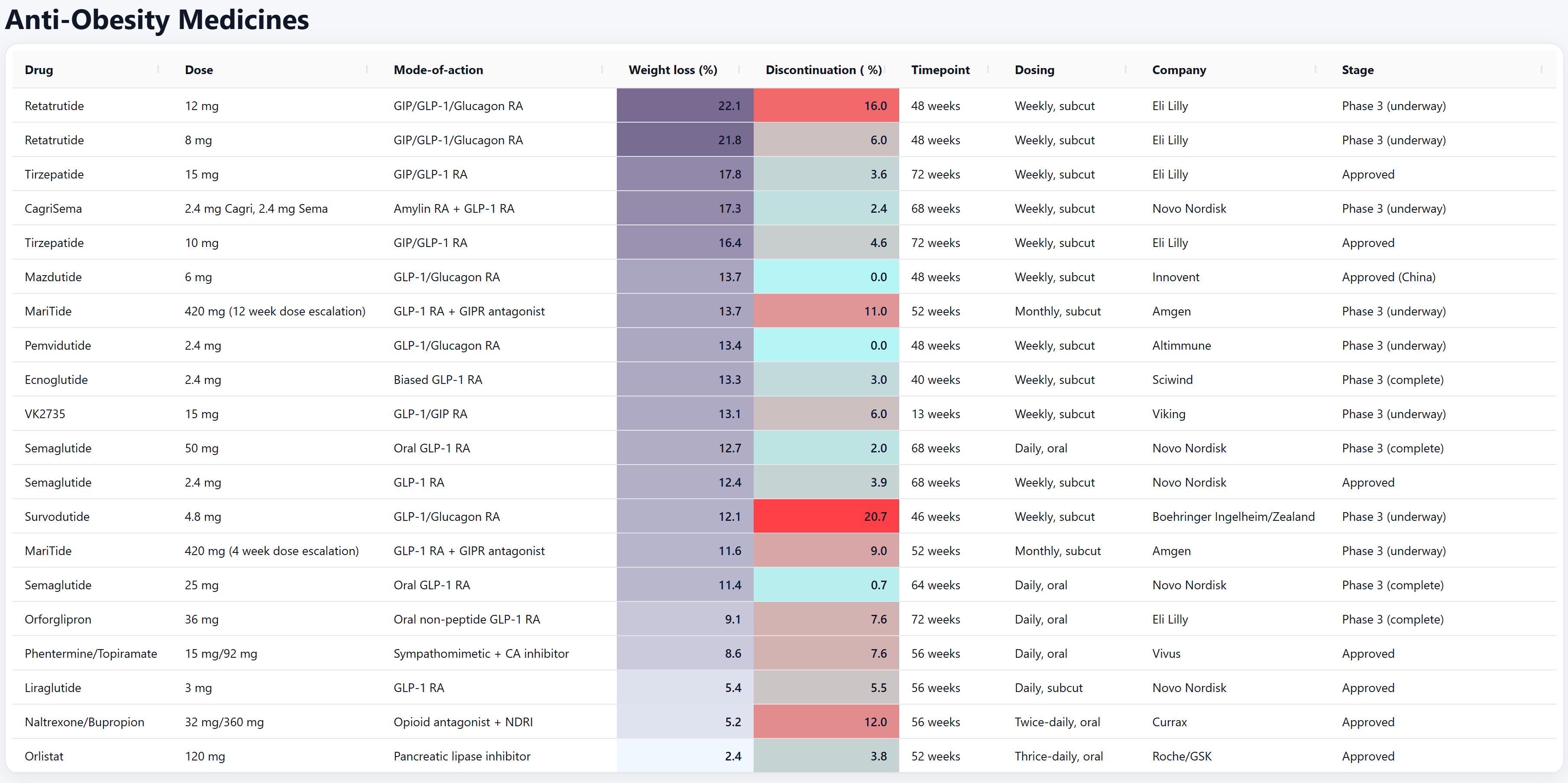
Orforglipron (at a dose of 36 mg) produced 9.1% placebo-adjusted weight loss, with 7.6% of patients dropping out due to adverse events. This compares to 11.4% placebo-adjusted weight loss with 25 mg of oral semaglutide (0.7% discontinuation).
So, semaglutide is winning — but it’s a peptide, which means it has strict administration rules: take it on an empty stomach, swallowed with <120 ml of water, and at least 30 minutes before or after other meds. Orforglipron is a non-peptide, and has none of these restrictions.
Here’s how they compare to the expanding pipeline of obesity medicines:
2. Aspirin prevents recurrence of PI3K-mutant colorectal cancer
If aspirin were discovered today, we would definitely be calling it a miracle drug. It helps treat stroke and heart attack, kills pain and reduces fever, and helps prevent pre-eclampsia.
Aspirin has anti-cancer benefits, too — it’s recommended as prophylaxis for high risk patients (with genetic conditions like Lynch syndrome) to prevent colorectal cancer.
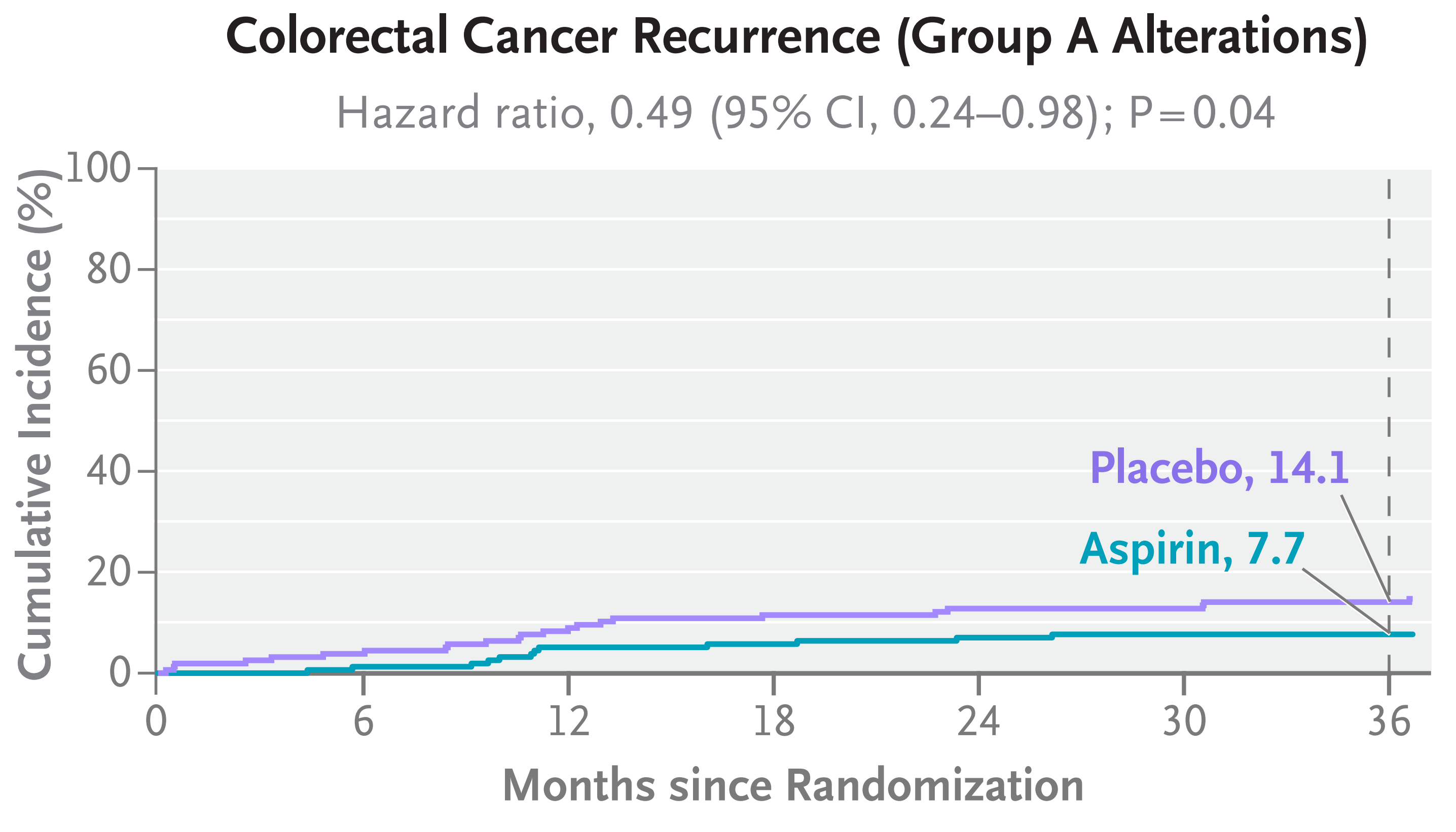
This trial tests whether low dose aspirin (160 mg) can prevent colorectal cancer recurrence after surgery — in the ~40% of patients who have PI3K pathway mutations. The molecular logic is that PI3K mutations increase the level of COX2 — a driving oncogene in colorectal cancer (and the target of aspirin).
Low-dose aspirin cut the risk of recurrence in half:
Aspirin isn’t totally benign, of course. It comes with risks of gastrointestinal bleeding, kidney damage, and allergy/intolerance. This means the risk: benefit ratio needs to be weighed up for each patient, individually — and it’s not indicated for people with no medical conditions.
But aspirin is cheap, very well-understood — and could immediately update the standard of care for these patients. Here’s the trial.
3. Trikafta wins a major prize
Globally, cystic fibrosis is the third most common life-limiting genetic condition (after sickle cell and haemophilia).
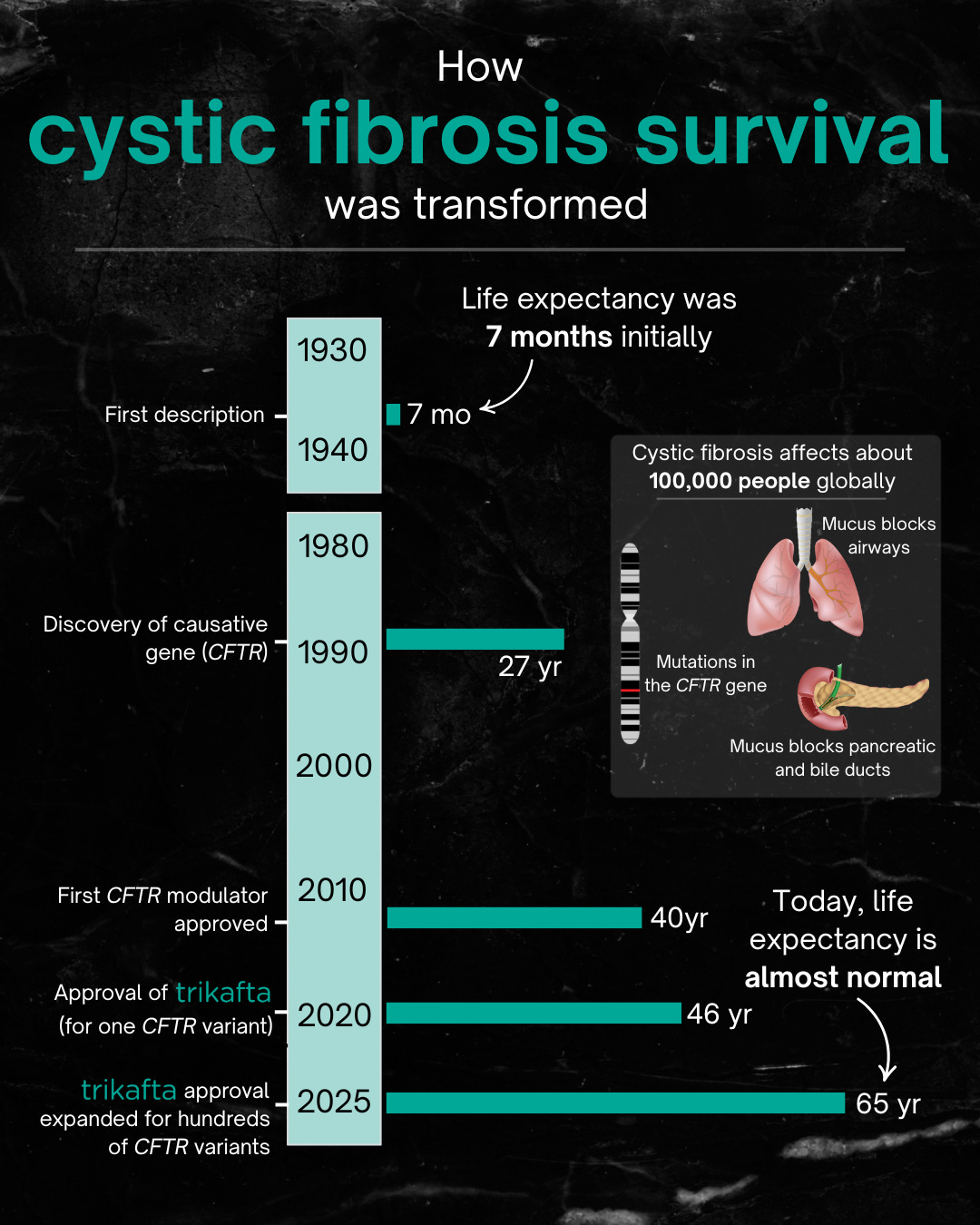
When it was first described, in 1938, life expectancy was about 7 months. The causative gene, CFTR (Cystic Fibrosis Transmembrane Conductance Regulator), was discovered in 1989, and a couple of years later CFTR was identified as a chloride ion channel. This explains the pathology: thick, sticky secretions that accumulate in multiple organs. In the lungs, this causes recurrent infections and bronchiectasis; in the pancreas, it causes pancreatic insufficiency and diabetes; and in the reproductive tract, it affects fertility.
Trikafta, made by Vertex Pharmaceuticals, transformed life expectancy for cystic fibrosis — it was approved for the first time in 2019, and means that average life expectancy in cystic fibrosis is almost normal now.
Trikafta is a combination of three molecules: Elexacaftor, which helps the misfolded CFTR protein escape degradation and reach the cell surface; Tezacaftor, a CFTR corrector that’s synergistic with Elexacaftor; and Ivacaftor, a CFTR potentiator — it keeps the CFTR channel open longer once it’s at the cell surface, improving chloride transport.
These breakthroughs led to Michael Welsh, Jesús González, and Paul Negulescu winning the 2025 Lasker–DeBakey Clinical Medical Research Award this week.
That doesn’t mean cystic fibrosis is solved. Not all cystic fibrosis mutations respond to Trikafta, some patients are intolerant to the drug, and it’s still very expensive — $26,000 per month. Precise gene editing might help solve these remaining problems.
